
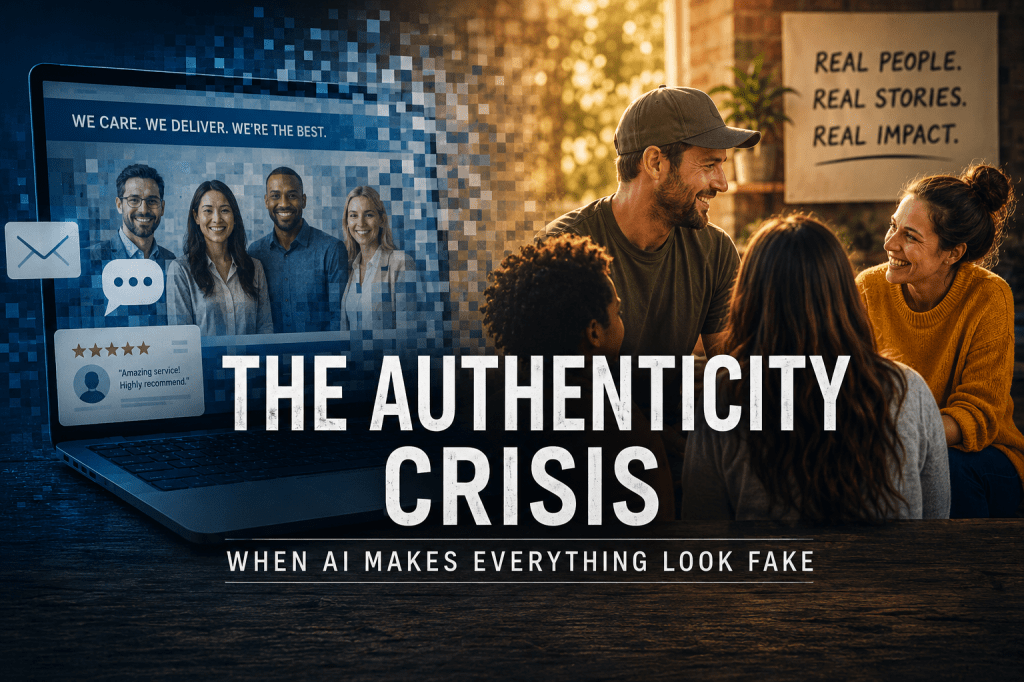
At Shepherd Security, most of our articles focus directly on cybersecurity threats, scams, technology, and protecting organizations from digital risks. This post is a little different.
We are going to talk about Artificial Intelligence (AI), and while there are many security concerns with AI, this article is not going to focus on controls, safeguards, best practices (we will create those post) but we are going to focus on something that is different, but foundational.
On the surface, it may not seem like a cybersecurity topic at all. It’s about authenticity, trust, relationships, and the growing role of artificial intelligence in how organizations communicate with the people they serve.
Trust is ultimately the foundation of security.
So, we all have heard the buzz word Artificial Intelligence, AI, or Gen AI by now. AI is one of the most powerful tools to emerge in decades. It can help us write emails, summarize reports, generate graphics, create videos, and automate tasks that once took hours.
Used wisely, AI is a force multiplier.
Used carelessly, it becomes something else entirely.
We’re entering a phase where many organizations are becoming so dependent on generative AI that their marketing, websites, social media posts, emails, and communications all start looking the same. The result isn’t innovation. It’s often the exact opposite.
It creates distance.
It creates distrust.
And ironically, it can make legitimate organizations look fake.
The Rise of the AI Gloss
You’ve probably seen it.
The perfectly crafted LinkedIn post.
The website filled with smiling yet shallow AI-generated stock-photos of people who don’t exist.
The customer testimonials that sound too polished.
The social media video that looks flawless but somehow feels empty.
The email that technically says all the right things, but somehow says nothing at all.
AI-generated content often suffers from what I call the “AI gloss.” Everything is polished. Everything is optimized. Everything is professional.
And yet nothing feels human.
People instinctively recognize when something feels manufactured. We may not always know why, but we know when a message lacks authenticity.
The problem isn’t that AI generated it.
The problem is that no real person seems to be behind it.
Trust Is Built Through Humanity
Trust has always been relational.
People trust people.
They trust stories.
They trust experiences.
They trust imperfections.
A recent report from Clutch states that research consistently shows that consumers place enormous value on authenticity. A recent survey found that 97% of consumers say authenticity influences whether they support a brand, while 85% have purchased from a brand specifically because it felt authentic.1
Another study from iStock found that 81% of respondents valued human-created content over AI-generated content because they viewed it as more authentic, original, and reflective of real human experiences.2
That should be a wake-up call for organizations rushing to replace every human touchpoint with AI-generated content.
People are not looking for perfection.
They’re looking for connection.
The Danger of Selling a False Narrative
One of the biggest risks with generative AI isn’t productivity.
It’s temptation.
The temptation to create a version of reality that doesn’t actually exist.
Need happy customers? Generate some.
Need a team photo? Create one.
Need testimonials? Write them.
Need a success story? Polish it until it’s barely recognizable.
The problem is that trust built on fiction eventually collapses.
When organizations use AI to exaggerate outcomes, invent customers, fabricate stories, or create an unrealistic image of who they are, they’re not building credibility. They’re borrowing against it.
Eventually reality catches up.
And when it does, the damage is often far greater than any short-term gains.
This principle applies far beyond marketing. In cybersecurity, we often talk about social engineering and deception. Trust is fragile because people make decisions based on what they believe is true.
When authenticity disappears, trust follows.
Churches, Nonprofits, and Mission-Driven Organizations Should Be Especially Careful
This issue becomes even more important for organizations whose mission is centered around people.
Churches.
Nonprofits.
Community organizations.
Counseling ministries.
Service-based businesses.
These organizations exist because of relationships.
If your mission is to serve people, encourage people, help people, disciple people, or support people, then your communication should reflect real people.
Real stories.
Real photos.
Real volunteers.
Real staff.
Real struggles.
Real victories.
A perfectly generated image of a family that never existed will never carry the same emotional weight as a real photograph of people whose lives were actually impacted.
A fictional testimonial may sound impressive.
A genuine testimony changes lives.
The Irony: Authentic Content Often Performs Better
For years, marketing teams believed that higher production value automatically created better engagement.
That assumption is increasingly being challenged.
Research suggests that audiences increasingly favor authentic and relatable content over highly polished productions. One consumer study found that 63% of people preferred relatable, authentic video content, while only 37% preferred highly produced videos. 3
Consumers are becoming increasingly skeptical of content that appears overly curated, overly perfect, or overly corporate. As AI-generated content floods the internet, genuine human content becomes more valuable—not less.
The things organizations are trying to hide; the imperfections, personality, real conversations, behind-the-scenes moments, are often the very things audiences connect with most.
AI Isn’t the Villain
This isn’t an anti-AI article.
I use AI.
Many organizations maybe should use AI if fitting.
AI can help draft content, brainstorm ideas, improve writing, summarize information, and eliminate repetitive work.
The issue isn’t the tool.
The issue is whether the tool is serving the truth or replacing it.
Use AI to help write your newsletter.
Don’t use it to invent customer stories.
Use AI to improve your grammar.
Don’t use it to create a fake version of your organization.
Use AI to save time.
Don’t use it to avoid being human.
Security Lessons from the Authenticity Crisis
At Shepherd Security, we spend a lot of time talking about phishing, scams, impersonation, and trust.
Generative AI has lowered the barrier for creating convincing deception. The same technology that helps businesses create content can also help criminals create fake websites, fake identities, fake voices, and fake narratives.
That makes authenticity more important than ever.
In a world where almost anything can be generated, the organizations that stand out will be the ones that are demonstrably real.
Real employees.
Real customers.
Real stories.
Real values.
Real relationships.
Trust is becoming one of the most valuable forms of security.
And trust is built through authenticity.
Final Thoughts
In a world where AI can generate convincing emails, realistic images, polished marketing campaigns, and even entirely fictional people, genuine human connection becomes increasingly valuable.
The future doesn’t belong to organizations that can generate the most content.
It belongs to organizations that can maintain credibility in a world flooded with artificial noise.
This isn’t an argument against artificial intelligence. AI is a powerful tool with many legitimate uses. But when technology begins replacing authenticity instead of supporting it, trust begins to erode.
And once trust is lost, it’s difficult to get back.
So while this article may not be directly about cybersecurity, it is about something every security professional, business leader, nonprofit director, church leader, and marketer should care about: building authentic trust in an increasingly artificial world.
1 (“Clutch Report: Brands Are Losing Consumer Trust Fast as 97% Demand Authenticity | Clutch.co”)
2 the, Crack. “Crack the Code on Trust: 2025 Marketing Insights for Small Businesses.” Getty Images Press Site – Newsroom – Getty Images, 17 Dec. 2024, newsroom.gettyimages.com/en/istock/crack-the-code-on-trust-2025-marketing-insights-for-small-businesses.
3 Roy, Orko. “The Authenticity Paradox: Why Highly Polished Culture Videos Fail to Resonate and How to Engineer Genuine Connection.” Advids.co, Advids, Oct. 2025, advids.co/insights/the-authenticity-paradox-why-highly-polished-culture-videos-fail-to-resonate-and-how-to-engineer-genuine-connection. Accessed 3 June 2026.

 shepherdsecurity.net
Leave a comment